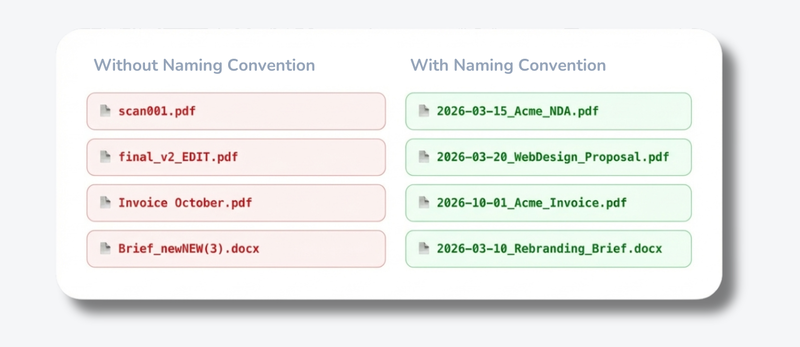
Need to rename hundreds of files with consistent names? File naming software (also called file renaming software) can batch rename files in seconds. Here’s what you need to know about the top tools and which one is right for you. Once you’ve picked a tool, our guide on file naming conventions covers how to build a consistent naming system to go with it.
Top File Naming Software Compared
1. Bulk Rename Utility (Windows)
Best for: Power users who need maximum flexibility
Price: Free (personal/home use), from $92.95 (commercial license for business use)
Bulk Rename Utility is a powerful Windows renaming tool that can handle 100,000+ files in a single operation. It offers extensive renaming options and is one of the most feature-rich free tools available. The Windows application itself is completely free to download and use for personal use at home. You only need to purchase a commercial license if you’re using it within a business or for commercial purposes.
Key Features:
- Add, remove, or replace text in file names
- Auto-numbering with custom formats
- Regular expression support
- EXIF data extraction (photos)
- File attribute modification
- Preview before renaming
- Undo functionality
| Pros ✅ | Cons ❌ |
|---|---|
| Extremely powerful | Overwhelming interface (100+ options visible) |
| Free for personal use | Steep learning curve |
| Fast performance | Windows only |
| Works with folders and files simultaneously | Requires manual configuration each time |
| Commercial license required for business use |
Best Use Case: Photographers renaming thousands of photos with EXIF data, or anyone doing complex one-time batch renames.
2. Advanced Renamer (Windows & Mac)
Best for: Users who want power with better organization
Price: Free (casual personal use), $25 personal license (frequent use, VAT included), $45 commercial license (plus VAT)
Advanced Renamer offers 13 different renaming methods and works on both Windows and Mac. The interface is more organized than Bulk Rename Utility, with methods presented as separate modules rather than all-at-once. You can download and use it free for casual personal use, but if you use the program frequently or for commercial purposes, a license is required to support continued development.
Key Features:
- 13 renaming methods (replace, remove, add, case change, etc.)
- Metadata extraction (EXIF, ID3, video tags)
- GPS-based naming (adds location to photos)
- JavaScript support for custom rules
- Batch modes (rename, copy, or move files)
- Import/export rename configurations
| Pros ✅ | Cons ❌ |
|---|---|
| Cross-platform (Windows & Mac) | Still requires technical knowledge |
| More organized interface than Bulk Rename Utility | Must set up rules for each session |
| Supports GPS coordinates in file names | Learning curve for JavaScript features |
| Can rename, move, and copy in same operation | No automatic file type detection |
| Free for casual use | License required for frequent/commercial use |
Best Use Case: Content creators managing photos and videos across multiple devices who need location-based naming.
3. PowerRename (Microsoft PowerToys)
Best for: Windows 10/11 users who want Microsoft integration
Price: Free
PowerRename is part of Microsoft PowerToys, a set of utilities for power users. It integrates directly into Windows Explorer’s right-click menu, making it the most accessible renaming tool on Windows.
Key Features:
- Right-click context menu integration
- Search and replace in file names
- Regular expression support
- Real-time preview
- Bulk rename files and folders
- Match case sensitivity
- Undo functionality
| Pros ✅ | Cons ❌ |
|---|---|
| Built by Microsoft (trusted source) | Windows 10/11 only |
| Integrates into Windows Explorer | Requires PowerToys installation |
| Simple for basic tasks, powerful for advanced | Less feature-rich than Bulk Rename Utility |
| Free and actively maintained | Still requires manual pattern definition |
| No separate application to open |
Best Use Case: Windows 10/11 users who want quick access to renaming without opening a separate application.
4. CleanName (Web-Based)
Best for: Quick renames + discovering if AI-powered naming is right for you
Price: Free (no account needed)
CleanName.io is a free web-based file renaming tool and a good way to see what AI-powered file naming can do. Upload your files, and it suggests clean, consistent names instantly. No installation, no account, no friction.
What makes CleanName different: Unlike the manual tools above, CleanName uses AI to understand your files and suggest appropriate names. It’s a glimpse into automated naming without the commitment of installing software.
Key Features:
- No software installation
- Works on any device
- AI-powered name suggestions
- Privacy-focused (files aren’t stored)
- Instant results
- Perfect for trying before you buy into automation
| Pros ✅ | Cons ❌ |
|---|---|
| Zero setup (works immediately) | Limited to web browser |
| Cross-platform (works in any browser) | Manual upload for each batch |
| Free with no account needed | Not ideal for thousands of files |
| Shows you what AI naming can do | One-time use (not continuous) |
Best Use Case: Quick renaming of a few files, or testing whether AI-powered naming makes sense for you before committing to a full automation solution like Filently.
5. Filently (Web / Google Drive)
Best for: Freelancers and small businesses who rename business documents continuously
Price: First 25 documents free, then from $6/month billed annually
Filently is the only tool on this list that renames files automatically, without you having to open it, create a pattern, or remember to run it. It connects to your Google Drive, reads the content of incoming documents (PDFs, Word docs, invoices, contracts), and applies your naming convention in the background.
Where every other tool on this list requires you to define a pattern and trigger the rename manually, Filently handles it the moment a file arrives. A supplier invoice comes in as invoice.pdf and becomes 2026-03-15_AcmeCorp_Invoice-1052.pdf, filed in the right folder, without you touching it.
Key Features:
- Reads document content, not just filenames
- Applies your naming convention automatically
- Files documents in the correct Google Drive folder
- Works continuously in the background
- Supports 20+ languages
- GDPR-compliant, CASA Tier 2 certified
| Pros ✅ | Cons ❌ |
|---|---|
| Fully automatic, no manual triggers | Requires Google Drive (Dropbox/OneDrive coming soon) |
| Reads and understands document content | Subscription required after 25 free documents |
| No patterns to configure | Not ideal for one-time photo batch renames |
| Works on any device | |
| First 25 documents free |
Best Use Case: Anyone who receives business documents regularly (invoices, contracts, briefs) and wants them named and filed automatically without any manual effort.
Quick Comparison: File Naming Software at a Glance
| Tool | Platform | Price | Best For | Difficulty |
|---|---|---|---|---|
| Filently ⭐ | Web / Google Drive | From $6/month | Ongoing business documents | Very Easy |
| Bulk Rename Utility | Windows | Free / from $92.95 | Power users | Hard |
| Advanced Renamer | Windows/Mac | Free / from $25 | Photo/video pros | Medium |
| PowerRename | Windows 10/11 | Free | Quick access | Easy |
| CleanName | Web | Free | Quick renames, testing AI naming | Very Easy |
⭐ First 25 documents free
Why Manual Renaming Tools Fall Short
These tools work great for one-time cleanups. Organizing 10,000 vacation photos? Perfect. Batch renaming music files? Excellent. As standalone file naming software, they do exactly what they promise.
But for ongoing business documents, they’re clunky. Here’s why:
You’re still doing the work. Every file needs a pattern. Every pattern needs your input. Invoice from Client A? Open tool, create pattern, apply. Invoice from Client B? Repeat. It’s manual labor with a fancy interface.
They can’t read content. Photos have EXIF data. Music has ID3 tags. But PDFs, Word docs, and invoices? No metadata. The tool can’t tell if “document.pdf” is an invoice, contract, or receipt. You have to.
They require discipline. You need to remember to use them, open them, and apply rules consistently. Miss a week when you’re busy? Files pile up with messy names. Your system breaks.
The Alternative: Automatic File Renaming Software
CleanName shows you what AI-powered naming feels like. Filently takes it further: it runs automatically in the background, so you never have to rename a file again. Every document that arrives in Google Drive gets the right name and lands in the right folder, without you touching it. Our guide on automating document filing shows the full setup.
Start free with Filently → First 25 documents free, no credit card needed.
Which Tool Should You Choose?
The honest answer depends on what you’re renaming.
If it’s a one-time job (old photos, a music library, a folder of scans), Bulk Rename Utility or Advanced Renamer will do it well. They’re free, powerful, and built exactly for that.
If you’re dealing with business documents that arrive regularly (invoices, contracts, briefs from clients), manual tools become a discipline problem. You have to remember to use them, set up the pattern each time, and actually run them. Most people don’t, and the files pile up.
That’s the gap Filently fills. As automated file renaming software, it runs in the background continuously. No patterns, no triggers, no catching up on Friday afternoon.
Not sure if automation is worth it for your volume? CleanName is a free way to test what AI-powered naming feels like before committing to anything.
Start free with Filently → First 25 documents free, no credit card needed.